Topic 4 of 5
Weather
Last reviewed
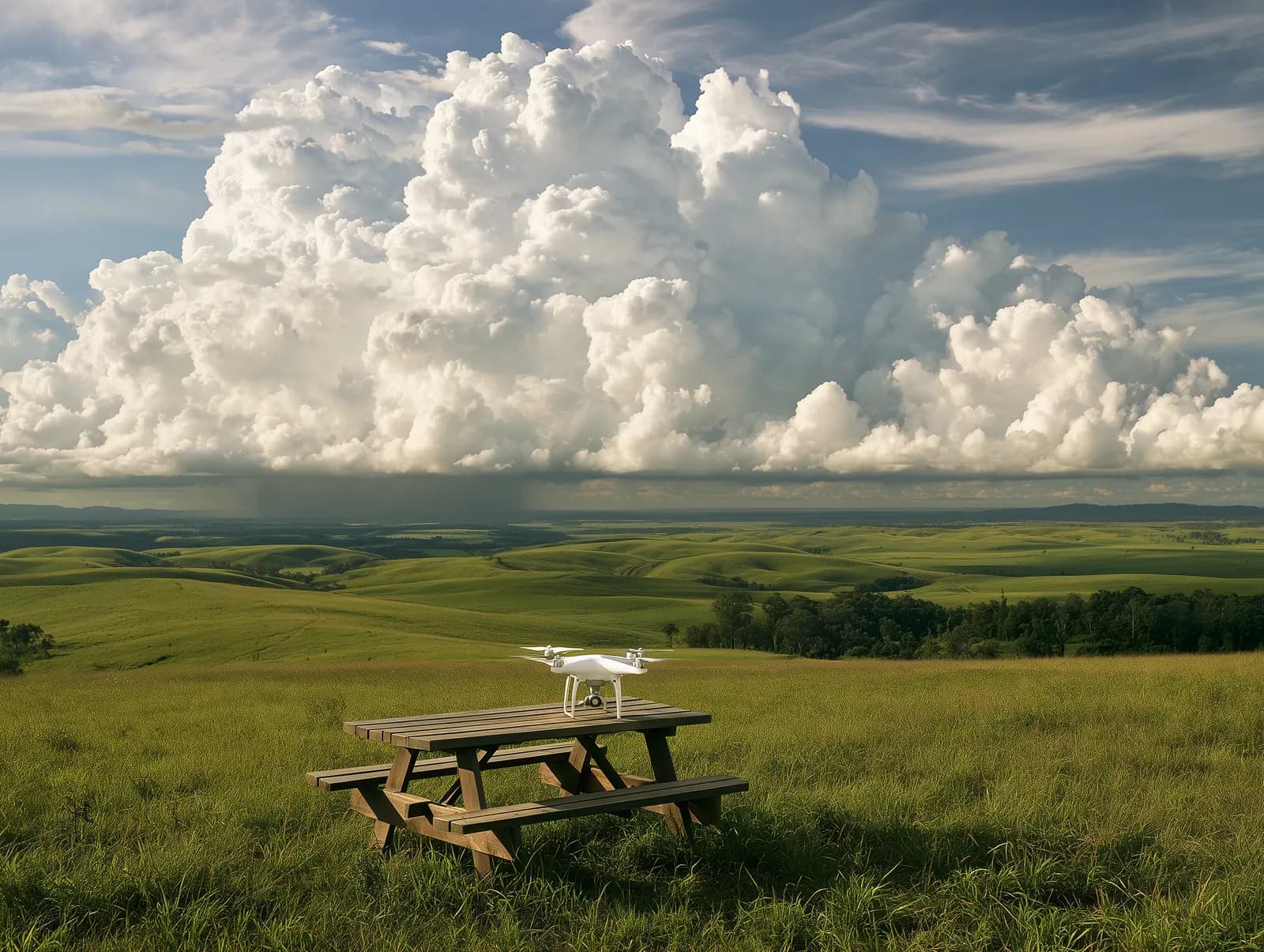
Weather questions cover where to find aviation weather and how it affects a small drone. Start with the two rules: you need at least 3 statute miles of visibility from the control station, and you must stay at least 500 feet below and 2,000 feet horizontally from clouds (14 CFR 107.51).
Reports and forecasts
A METAR is a report of current surface weather at an airport in a standard international format; a SPECI is a special report issued between routine ones when conditions change (FAA Remote Pilot Study Guide, p. 15). Times are in UTC, shown with a "Z" (FAA Remote Pilot Study Guide, p. 16-18). A TAF is a forecast for the area within 5 statute miles of an airport, valid for 24 or 30 hours and written with the same codes as a METAR (FAA Remote Pilot Study Guide, p. 18).
Density altitude
Thinner air means worse performance. High elevation, low pressure, high temperature and high humidity all raise density altitude and reduce how well an aircraft performs (FAA Remote Pilot Study Guide, p. 21).
Wind
Buildings and terrain break up the wind and create gusts that change quickly in speed and direction (FAA Remote Pilot Study Guide, p. 23). Wind shear is a sudden change in wind speed or direction over a small area, and a microburst, its most severe low-level form, can produce downdrafts of up to 6,000 feet per minute (FAA Remote Pilot Study Guide, p. 23-24).
Stability, fog and frost
Stable air tends to bring stratiform clouds, fog, smooth air and poor visibility in haze; unstable air brings cumuliform clouds, showers, turbulence and good visibility (FAA Remote Pilot Study Guide, p. 26). When temperature and dew point are close together, fog and low clouds are likely (FAA Remote Pilot Study Guide, p. 25). Frost reduces lift and increases drag, so clean it off before flying (FAA Remote Pilot Study Guide, p. 25).
Thunderstorms
A thunderstorm cell goes through three stages: cumulus, mature and dissipating. Every hazard is at its worst in the mature stage (FAA Remote Pilot Study Guide, p. 26-27). Don't fly near rapidly building cumulus clouds (FAA Remote Pilot Study Guide, p. 27).
Learn mode
Practice questions
Pick an answer to see whether it's right, with the explanation and FAA source.
Beta: these questions haven't been reviewed by a certified remote pilot yet. Spot a mistake? Report it.
Questions 1-10 of 29
Ready for a mixed set?
Take 20 questions from every topic and get a score with explanations.
Take the free test