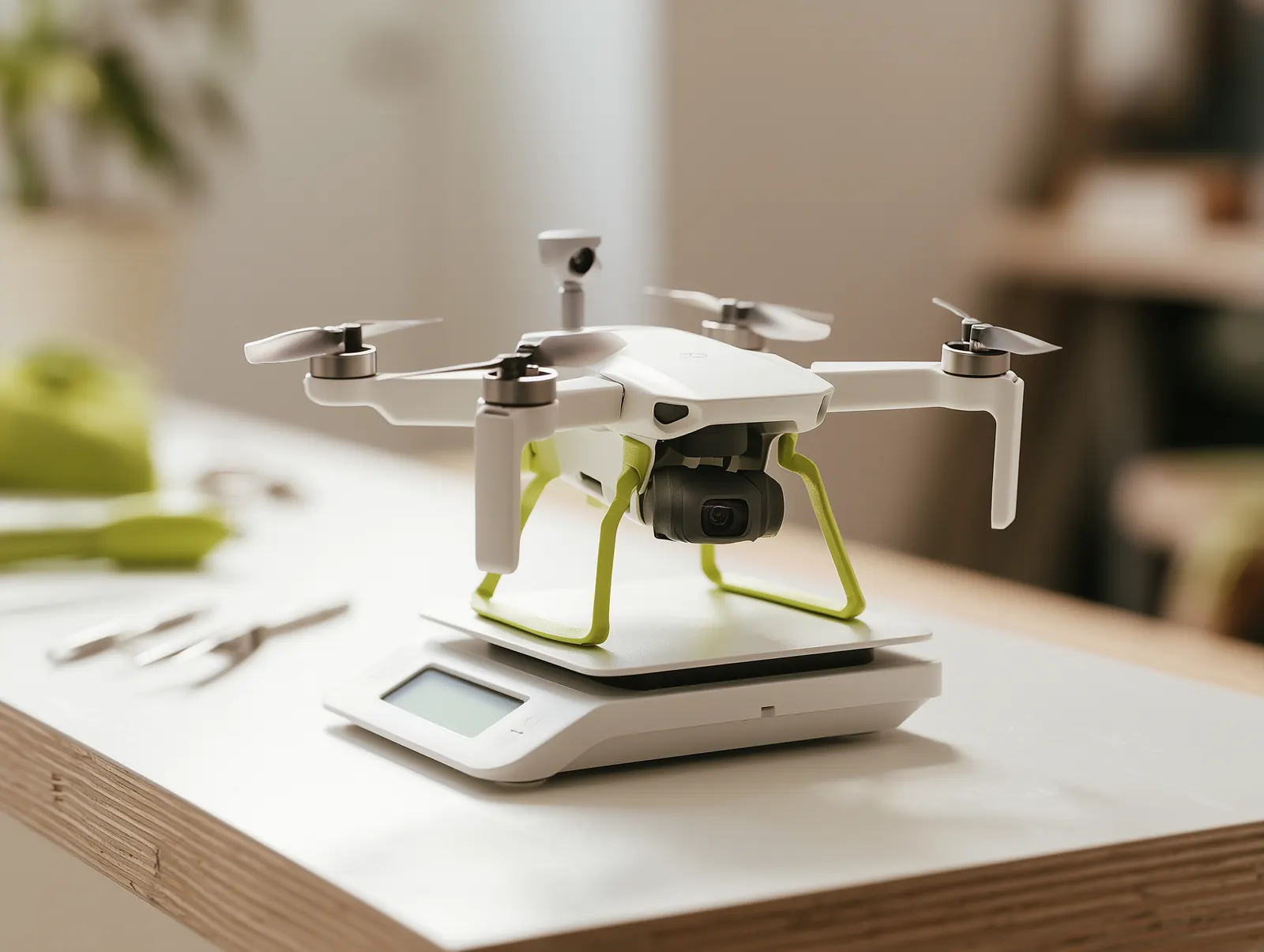
Every payload you add, from a camera to a spray tank, changes two things: how much your aircraft weighs and where that weight sits. Get either one wrong and the aircraft may climb poorly, handle strangely or be hard to control. Before any flight, the FAA expects the remote pilot in command to confirm the aircraft is correctly loaded by checking its weight and balance (FAA Remote Pilot Study Guide, p. 29).
Weight and lift
Weight is the force with which gravity pulls a body toward the center of the Earth (FAA Remote Pilot Study Guide, p. 32). Lift is the only force that counteracts weight, and the amount of lift a wing can make is limited by its design, its angle of attack, its airspeed and the air density (FAA Remote Pilot Study Guide, p. 32). If the weight is greater than the lift generated, the aircraft may not be able to fly at all (FAA Remote Pilot Study Guide, p. 32). In stabilized level flight, lift equals weight (FAA Remote Pilot Study Guide, p. 30).
Part 107 also caps the total. A small unmanned aircraft weighs less than 55 pounds on takeoff, including everything on board or otherwise attached to it (14 CFR 107.3), so any payload counts toward that limit (AC 107-2A, para. 5.15.1).
What extra weight does
Added weight makes the aircraft fly at a higher angle of attack to hold its altitude and speed. That adds drag, so more thrust is needed and less is left over for climbing (FAA Remote Pilot Study Guide, p. 22). The study guide lists the most important effects of an overloaded aircraft (FAA Remote Pilot Study Guide, p. 33):
- Higher takeoff speed and a longer takeoff run
- Reduced rate and angle of climb, and a lower maximum altitude
- Shorter range and reduced cruising speed
- Reduced maneuverability and a higher stalling speed
- Higher approach and landing speed, and a longer landing roll
If an aircraft isn't loaded properly, the first sign of poor performance usually shows up during takeoff (FAA Remote Pilot Study Guide, p. 33). Overloading also hurts stability: an aircraft that is stable and controllable at a normal weight can behave very differently when overloaded (FAA PHAK, p. 5-43). Repeated overloading is worse than it looks, because it can cause cumulative structural damage that a preflight inspection may not find, leading to a failure later in completely normal flight (FAA PHAK, p. 5-43).
Balance and the center of gravity
The center of gravity (CG) is the point where all of the aircraft's weight can be considered concentrated. Supported at exactly that point, the aircraft would balance in any attitude (FAA Remote Pilot Study Guide, p. 29). The CG isn't a fixed point marked on the airframe: it depends on how the weight is spread out, so it moves whenever a load is shifted, added or used up (FAA Remote Pilot Study Guide, p. 29).
Lift acts at a different point, the center of pressure (CP). When the CG is ahead of the CP, the aircraft tends to pitch nose down; when the CP is ahead of the CG, it tends to pitch nose up (FAA Remote Pilot Study Guide, p. 29). Flying with the CG outside the approved limits makes the aircraft hard to control (FAA Remote Pilot Study Guide, p. 32). What that feels like depends on which way the CG is off:
- Too far forward (nose heavy): raising the nose becomes difficult, especially at takeoff and landing, and you can expect higher stalling speeds and higher control forces (FAA PHAK, p. 10-3).
- Too far aft (tail heavy): stability gets worse, stall recovery becomes harder, and control forces become very light, which makes it easy to overstress the aircraft (FAA PHAK, p. 10-3).
- Off to one side: lateral unbalance makes one wing heavy. Holding a constant correction against it increases drag and reduces efficiency (FAA PHAK, p. 10-2 to 10-3).
Why position matters as much as weight
The turning effect of a weight is called its moment: the weight multiplied by its distance (the arm) from a reference point called the datum. For example, 50 pounds placed 100 inches from the datum creates a moment of 5,000 inch-pounds (FAA PHAK, p. 10-6). The practical lesson is that the same accessory shifts the balance much more when it sits far from the CG than when it sits close to it. It also explains why moving a battery or camera mount can push the CG out of limits without changing the total weight at all (FAA Remote Pilot Study Guide, p. 29).
Weight that changes in flight
Weight can change during a flight. In manned aircraft that is usually fuel burn; in a small unmanned aircraft it may be an expendable item, such as a load you release (FAA Remote Pilot Study Guide, p. 29). A lighter aircraft performs better, but the change can upset the balance (FAA Remote Pilot Study Guide, p. 29), so work out ahead of time how the CG will shift and what that will do to the aircraft (AC 107-2A, para. B.2.2). Any release must also not create an undue hazard to people or property (14 CFR 107.23(b)).
The rules and the manufacturer's limits
Follow the weight and balance limits set by the manufacturer or builder; complying with them is critical to flight safety (AC 107-2A, para. B.2.1). The FAA encourages manufacturers to publish maximum weights and weight and balance information for their aircraft (AC 107-2A, para. 8.12.2.5.1 and 8.12.2.5.3). Before every flight, Part 107 requires you to make sure that anything attached to or carried by the aircraft is secure and doesn't adversely affect its flight characteristics or controllability (14 CFR 107.49(e)), and the whole system must be in a condition for safe operation (14 CFR 107.15(a)).
A maximum takeoff weight isn't a promise that the aircraft can take off safely with that load in every condition. High elevations, high temperatures and high humidity (high density altitude) may call for less weight, and so can a short, sloping or rough launch area, the surface wind or obstacles (AC 107-2A, para. B.2.1.1). If the CG is outside the limits after loading, or won't stay within them, relocate or remove weight before you fly (FAA Remote Pilot Study Guide, p. 29).
Worked example
You plan a mapping flight with a fixed-wing small unmanned aircraft that weighs 9 pounds. Its manual gives a maximum takeoff weight of 11 pounds and an allowed CG range. You want to add a 1.5-pound thermal camera on a mount under the nose, and the site is a high, hot field in the middle of the afternoon.
- Total weight. 9 + 1.5 = 10.5 pounds. That is under the manual's 11-pound limit and far under the 55-pound Part 107 limit, which includes everything attached (14 CFR 107.3).
- Conditions. Being under the maximum isn't the end of the check. Hot, high conditions mean a high density altitude, which may require a reduction in weight (FAA Remote Pilot Study Guide, p. 29). With only half a pound of margin, consider a lighter camera or a cooler, earlier flight.
- Balance. The camera sits well forward of the CG, so it pulls the CG forward. Check the loaded CG against the manual's range. Beyond the forward limit, expect a nose-heavy aircraft that is hard to raise at launch and landing (FAA PHAK, p. 10-3), so move or remove weight first (FAA Remote Pilot Study Guide, p. 29).
- Security. Confirm the mount is tight and the camera doesn't adversely affect control (14 CFR 107.49(e)).
Only when all four checks pass is the aircraft ready to fly.
Common mistakes
- Treating the maximum takeoff weight as safe in all conditions. Hot, high or humid air may require less.
- Thinking the CG is a fixed point. It moves whenever weight is added, moved or released.
- Forgetting that a payload counts toward the 55-pound limit.
- Mixing up the CG, where weight acts, with the center of pressure, where lift acts.
- Checking only nose-to-tail balance and ignoring a payload hung off to one side.
- Assuming a slightly overweight flight that went fine is safe to repeat. Damage can build up unseen.