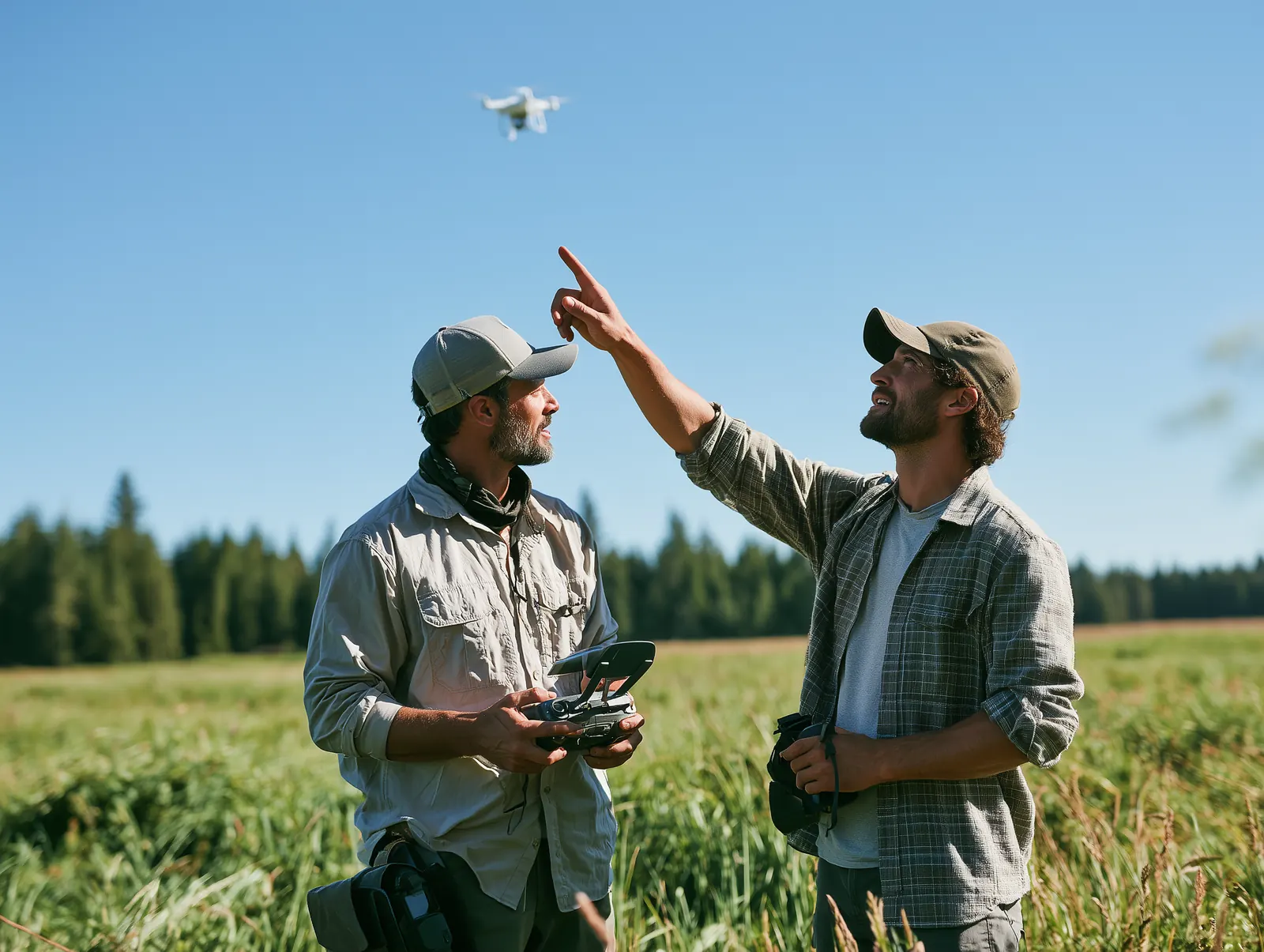
You share low airspace with manned aircraft: helicopters, agricultural aircraft, light airplanes and military aircraft may all fly below 400 feet AGL (AIM 11-8-3). Near airports, their pilots tell each other where they are by radio. Part 107 doesn't require you to use a radio, but understanding "aviation language" and listening on the right frequency gives you an extra layer of situational awareness (FAA Remote Pilot Study Guide, pp. 39, 41).
Listen, don't talk
Remote pilots are not expected to talk to manned aircraft, and the FAA study guide says you should not transmit on any active aviation frequency unless there is an emergency (FAA Remote Pilot Study Guide, pp. 41-42). The AIM adds that small UAS operators should not contact air traffic control by radio or telephone for airspace access, and that using an aviation frequency may break Federal Communications Commission rules (AIM 11-8-2). Airspace authorizations go through processes such as LAANC and DroneZone, not radio calls (AIM 11-8-2). What the AIM does encourage is monitoring the local CTAF when you fly on or near an airport (AIM 11-8-2).
CTAF, UNICOM and MULTICOM
At an airport without an operating control tower, pilots coordinate on one shared frequency. The Common Traffic Advisory Frequency (CTAF) is the frequency designated for airport advisory practices there. It may be a UNICOM, MULTICOM, flight service station or tower frequency (AIM 4-1-9).
- UNICOM is a non-government air/ground radio station that may provide airport information at public-use airports with no tower or flight service station. On request, the operator may give weather, wind direction or the recommended runway (AIM 4-1-9).
- MULTICOM (122.9 MHz) is used for self-announce calls where there is no tower, flight service station or UNICOM on the airport (AIM 4-1-9).
- Part-time towers: when the tower is closed and there is no open flight service station on the field, pilots self-announce on the CTAF (AIM 4-1-9).
UNICOM is often 122.8 MHz, but neighboring airports may use other frequencies, so always check (FAA Remote Pilot Study Guide, p. 40). The frequencies set aside for airports without an operating tower are 122.700, 122.725, 122.800, 122.975, 123.000, 123.050 and 123.075 MHz (AIM 4-1-11). An airport's CTAF is listed in the Chart Supplement (AIM 4-1-9) and in the airport's data block on the sectional chart, where a small symbol follows it (Chart Users' Guide).
The phonetic alphabet and spoken numbers
Pilots use the ICAO phonetic alphabet to identify their aircraft and to spell out letters clearly (AIM 4-2-7): Alfa, Bravo, Charlie, Delta, Echo, Foxtrot, Golf, Hotel, India, Juliett, Kilo, Lima, Mike, November, Oscar, Papa, Quebec, Romeo, Sierra, Tango, Uniform, Victor, Whiskey, Xray, Yankee, Zulu.
Some digits sound different on the radio: 3 is "tree," 4 is "fow-er," 5 is "fife" and 9 is "niner" (AIM 4-2-7). Most numbers are read digit by digit, and the decimal point in a frequency is "point," so 122.1 is "one two two point one" (AIM 4-2-8). Altitudes below 18,000 feet MSL are spoken as thousands and hundreds: 12,500 is "one two thousand five hundred" (AIM 4-2-9). Times are given in Coordinated Universal Time, which may be called "Zulu" (AIM 4-2-12).
Call signs
Every US-registered aircraft has an "N" number: N123AB in full is "November One-Two-Three-Alpha-Bravo" (FAA Remote Pilot Study Guide, p. 42). When the pilot gives the manufacturer's name or the model instead, the "N" is dropped, as in "Cessna One-Two-Three-Alpha-Bravo" (AIM 4-2-4). Airliners use the company name and flight number (FAA Remote Pilot Study Guide, p. 42). The call sign at the start of each call tells you which aircraft is talking, and often what make it is.
How pilots announce their positions
At non-towered airports, inbound pilots should monitor and talk on the CTAF from 10 miles out until landing. Departing pilots do the same from start-up, during taxi, and until 10 miles from the airport (AIM 4-1-9). The recommended calls for arrivals are about 10 miles out, entering downwind, base and final, and leaving the runway; departures call before taxiing and before taxiing onto the runway (AIM 4-1-9).
A self-announce call starts and ends with the airport name, because aircraft at nearby airports may be on the same frequency, and it names runways by number rather than saying "active runway" (AIM 4-1-9). In between come the call sign, the position and the intentions. A typical arrival call sounds like this: "Maple Valley traffic, Cessna Four Two Seven Delta Kilo, ten miles south, inbound for landing, Maple Valley."
Don't count on hearing every aircraft. Some have no radio, and some pilots don't announce themselves (AIM 4-1-9). Radio calls at non-towered airports are good practice but not required by regulation, so keep scanning the sky and treat the radio as an extra layer (FAA Remote Pilot Study Guide, p. 41).
Towered airports, ATIS and who is being called
At an airport with an operating control tower, pilots must keep two-way radio contact with the tower inside the Class B, C or D surface area unless the tower authorizes otherwise, and they normally make the first call about 15 miles out (AIM 4-3-2). Many airports also broadcast ATIS, a recorded loop of weather, runways in use and other airport information. It is normally updated once an hour, and each update gets the next phonetic letter, so "information Bravo" replaces "information Alpha" (FAA Remote Pilot Study Guide, p. 67).
The first words of a call tell you who is being called: a UNICOM is called by airport name plus "UNICOM," a flight service station is "Radio," and tower, ground and approach controllers are "Tower," "Ground" and "Approach" (AIM 4-2-6). Towers handle traffic on and in the vicinity of their airport (AIM 4-1-2), so an airplane calling "Tower" is at or near that airport.
Worked example
You are inspecting a barn roof about 2 miles southeast of Maple Valley, a non-towered airport, flying at 150 feet AGL in Class G airspace with a visual observer. Your handheld radio is tuned to the CTAF from the sectional chart. You hear: "Maple Valley traffic, Piper Six Eight Five Romeo Quebec, eight miles southeast, two thousand five hundred, inbound for landing, Maple Valley."
- Who: a Piper. Digits are read one at a time and Romeo Quebec spells RQ, so it is N685RQ (AIM 4-2-7).
- Where and what: 8 miles southeast, on your side of the airport, planning to land. Expect calls on downwind, base and final (AIM 4-1-9).
- Act: ask your observer to watch the southeast sky, and keep the drone low and close to the barn, ready to descend. You must yield right of way and not fly so close to the airplane that you create a collision hazard (14 CFR 107.37).
Next you hear "left downwind, runway three-four." Downwind runs parallel to the runway, opposite to the landing direction (AIM 4-3-2). Aircraft landing on runway 34 head north-northwest, so final approach comes in from the south-southeast, not far from your barn. You keep the drone low and wait until you hear "clear of runway three-four" before climbing again. At no point do you transmit: the pilot needs nothing from you, and your job is to stay clear.
Common mistakes
- Announcing your drone on the CTAF. Don't transmit unless there is an emergency (FAA Remote Pilot Study Guide, p. 41).
- Treating a radio call as permission. Flying in Class B, C or D airspace or a Class E surface area needs prior ATC authorization (14 CFR 107.41), obtained through processes such as LAANC or DroneZone (AIM 11-8-2).
- Assuming a quiet frequency means an empty sky. Aircraft without radios still fly.
- Assuming every UNICOM is 122.8. Check the chart or the Chart Supplement.
- Mixing up phonetic words, such as writing K for Quebec or N for niner. Practice until the list is automatic.